
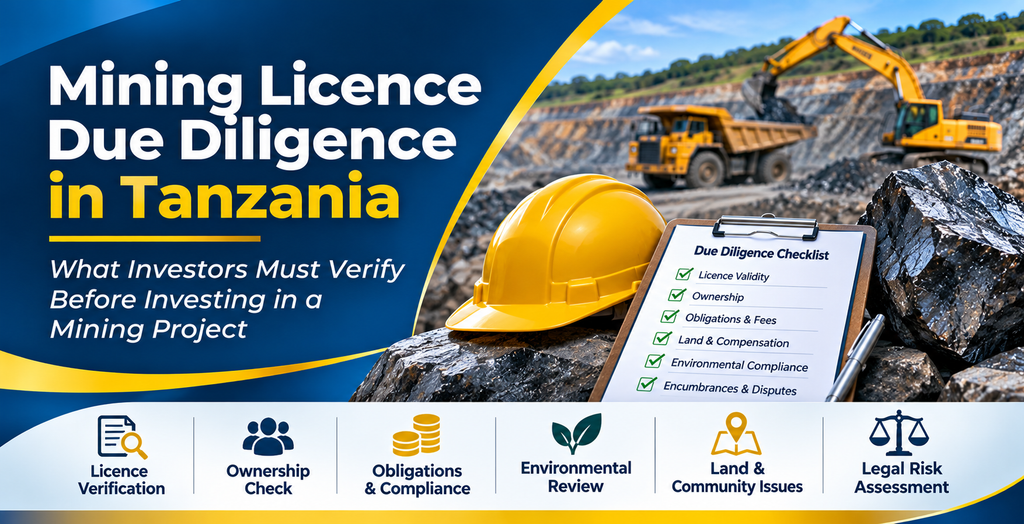
Mining Licence Due Diligence in Tanzania: Investor Guide
Tanzania offers significant mining investment opportunities in gold, graphite, copper, lithium, gemstones and other valuable minerals. However, acquiring a mining licence or investing in an existing mining company without conducting comprehensive legal due diligence can expose investors to substantial financial, legal and operational risks.
A mining licence may appear genuine and commercially attractive while carrying undisclosed liabilities, ownership disputes, outstanding statutory obligations or restrictions on transfer.
Whether you are acquiring a Prospecting Licence (PL), purchasing a mining company, negotiating a joint venture or financing a mineral exploration project, conducting mining licence due diligence in Tanzania is an essential step before committing investment capital.
This article explains the key legal, regulatory, financial and technical matters that investors should verify before investing in Tanzania’s mining sector.
1. What Is Mining Licence Due Diligence?
Mining licence due diligence is a comprehensive investigation undertaken to establish the legal validity, ownership, regulatory compliance and commercial risks associated with a mineral right or mining project.
The primary objective is to establish whether the proposed investment is legally permissible, whether the seller has the authority to complete the transaction and whether the mineral right is subject to undisclosed obligations.
Due diligence should be conducted before:
- Purchasing an existing mining or prospecting licence.
- Acquiring shares in a mining company.
- Entering into a mining joint venture agreement.
- Financing mineral exploration or mining operations.
- Acquiring an existing mining project.
- Entering into mineral supply or offtake agreements.
2. Legal Framework Governing Mining Investments in Tanzania
Mining licence acquisitions and investments in Mainland Tanzania are principally governed by:
- The Mining Act, Cap. 123 R.E. 2023, as amended.
- The Mining (Mineral Rights) Regulations, 2018, as amended.
- The Mining (Local Content) Regulations, 2018, as amended.
- The Mining (State Participation) Regulations, 2022.
- The Environmental Management Act.
- The Companies Act.
- The Land Act and Village Land Act.
- Applicable taxation and natural resources legislation.
The Tanzania Mining Commission is the principal authority responsible for administering mineral rights and monitoring compliance with mining legislation.
3. What Investors Must Verify Before Acquiring a Mining Licence
3.1. Authenticity and Validity of the Mining Licence
The first step is to establish whether the mineral right genuinely exists and remains legally valid. Investors should independently verify:
- Mineral right identification number.
- Registered licence holder.
- Date of issuance and expiry.
- Authorised minerals.
- Licence category.
- Geographical coverage.
- Current regulatory status.
- Pending suspension or cancellation proceedings.
- Renewal applications and their status.
A copy of a mining licence supplied by a seller or mining broker should not be treated as conclusive evidence of its current validity. Independent verification with the Mining Commission is strongly recommended.
3.2. Ownership and Authority of the Seller
Investors must establish whether the person negotiating the transaction is the registered mineral rights holder or a legally authorised representative.
Where the mineral right is held by a company, the investigation should extend to its shareholders, directors, beneficial owners and corporate decision-making authority.
Relevant documents may include the certificate of incorporation, memorandum and articles of association, company search report, board resolutions, shareholders’ resolutions, powers of attorney and existing shareholders’ agreements.
Where an intermediary is involved, the investor should request written evidence of the intermediary’s mandate from the registered licence holder.
3.3. Type of Mining Licence and Investor Eligibility
Not every mineral right can be acquired by a foreign investor.
| Licence category | Key consideration |
|---|---|
| Prospecting Licence (PL) | Authorises mineral exploration rather than ordinary commercial mining. |
| Primary Mining Licence (PML) | Reserved for eligible Tanzanian citizens and qualifying Tanzanian-owned entities. |
| Mining Licence (ML) | Authorises commercial mining subject to statutory requirements. |
| Special Mining Licence (SML) | Applicable to large-scale mining investments. |
| Processing Licence | Authorises mineral processing within its approved scope. |
Foreign investors must ensure that the proposed acquisition or joint venture does not circumvent statutory ownership restrictions.
3.4. Geographical Coordinates and Licence Boundaries
The geographical area covered by a mining licence is fundamental to its commercial value.
Investors should verify the licence coordinates, total surface area, physical location, boundary demarcation and any overlapping mineral rights. Particular attention should be given to:
- Forest reserves and protected areas.
- Village and privately occupied land.
- Restricted mining areas.
- Existing infrastructure and settlements.
- Accessibility of the mining site.
- Areas surrendered during previous licence renewals.
An independent site inspection and geographical assessment should be undertaken where appropriate.
3.5. Outstanding Annual Rents and Statutory Payments
A mining licence may remain registered while carrying significant outstanding financial obligations.
Investors should establish whether the licence holder has paid all applicable annual rents, royalties, regulatory fees, inspection charges, taxes and penalties.
Outstanding statutory obligations may affect licence renewal, transfer approval and continued operations. Failure to pay annual rents or royalties can also attract statutory penalties.
The acquisition agreement should clearly establish who will be responsible for settling historical liabilities.
3.6. Exploration and Development Obligations
Holders of mineral rights are required to comply with applicable work programmes, expenditure commitments, reporting requirements and licence conditions. For a Prospecting Licence, investors should examine:
- Approved exploration work programmes.
- Minimum exploration expenditure requirements.
- Geological and geophysical survey reports.
- Drilling programmes and results.
- Quarterly and annual reports.
- Evidence of exploration activities.
- Correspondence with the Mining Commission.
- Outstanding regulatory directives.
Failure to comply with exploration and development obligations may jeopardise the continued validity or renewal of a mineral right.
3.7. Licence Expiry and Renewal Eligibility
Investors should not assess the value of a mineral right solely by its geographical size or geological potential. The remaining licence period is equally important.
A Prospecting Licence approaching its final expiry date may present considerable investment risks, particularly where substantial exploration work remains outstanding.
The due diligence exercise should establish whether further renewal is legally available, whether renewal applications have been submitted on time and whether applicable renewal conditions have been satisfied.
3.8. Mortgages, Encumbrances and Third-Party Interests
A mining licence or the company holding it may be subject to existing financial or contractual obligations. Investors should investigate whether the project is affected by:
- Registered mortgages and charges.
- Existing joint venture agreements.
- Options to acquire mineral rights.
- Mineral offtake agreements.
- Shareholder loans.
- Profit-sharing arrangements.
- Outstanding contractual commitments.
- Court orders or pending litigation.
These obligations may restrict the seller’s ability to transfer the mineral right or affect the investor’s future control of the project.
4. Geological and Technical Due Diligence
Legal ownership of a mining licence does not guarantee the existence of commercially recoverable mineral deposits. Before investing, investors should engage qualified geologists and mining engineers to assess the technical viability of the project.
The technical investigation should consider geological reports, historical exploration results, laboratory assay certificates, drilling data, mineral grades, resource estimates, metallurgical test results, recovery rates and anticipated development costs.
Where a seller claims that a project contains substantial mineral resources, the investor should establish whether those claims are supported by independently verifiable geological evidence.
A valid mining licence is not necessarily a commercially viable mining project.
5. Land Rights and Compensation Obligations
One of the most significant risks associated with mining investments in Tanzania concerns land access and compensation.
A mineral right does not automatically extinguish the rights of lawful landowners and occupiers within the licensed area.
Sections 121 and 122 of the Mining Act, Cap. 123 R.E. 2023, address compensation, relocation and resettlement obligations arising from prospecting and mining activities. Investors should establish:
- Whether the licensed area is occupied by individuals or communities.
- Whether land valuation has been undertaken.
- Whether compensation arrangements have been concluded.
- Whether affected landholders have received compensation.
- Whether compensation disputes remain unresolved.
- Whether relocation or resettlement is necessary.
- Whether the proposed operations are consistent with applicable land-use requirements.
Unresolved land compensation obligations can substantially increase project development costs and delay mining operations.
6. Environmental Compliance and Historical Liabilities
Environmental due diligence is particularly important when acquiring an existing or previously operational mining project.
Investors should verify applicable environmental impact assessment certificates, environmental management plans, environmental audit reports, water permits, waste management arrangements and rehabilitation obligations.
Where mining operations have previously taken place, the investigation should establish whether the project has outstanding environmental restoration or mine closure liabilities.
Acquiring shares in a mining company may expose the investor to historical environmental liabilities through the acquired company.
7. Government Participation in Mining Companies
Foreign investors must consider government participation requirements when acquiring or developing commercial mining projects.
Section 11 of the Mining Act provides for a minimum 16% non-dilutable free carried interest for the Government in companies undertaking mining operations under Mining Licences and Special Mining Licences.
Due diligence should establish whether government participation arrangements have been implemented and whether the company’s existing ownership structure complies with applicable requirements.
These matters are particularly important when determining investment valuation, equity allocation, financing arrangements and anticipated returns.
8. Mining Local Content Compliance
Investors acquiring existing mining projects should investigate whether the licence holder has complied with applicable mining local content regulations.
The assessment should cover employment and training of Tanzanian citizens, procurement arrangements, engagement of local service providers, local content plans, reporting obligations and expatriate succession arrangements.
Historical non-compliance should be identified before completion of the transaction to avoid unexpected regulatory exposure.
9. Mining Licence Acquisition vs Mining Company Acquisition
Investors may acquire a mineral right directly or purchase shares in the company holding the mineral right.
The two investment structures have different legal and commercial implications.
| Consideration | Mineral rights acquisition | Share acquisition |
|---|---|---|
| Transaction subject | Mineral right | Shares in the licence-holding company |
| Licence holder | Changes upon effective transfer | Generally remains the same company |
| Historical corporate liabilities | Generally more limited, subject to applicable law | Remain within the acquired company |
| Regulatory approvals | Applicable transfer requirements | Applicable ownership and change-of-control requirements |
| Due diligence scope | Mineral right and associated obligations | Entire company and mining project |
| Tax implications | Mineral rights transaction taxes | Share transaction and related tax obligations |
Purchasing shares in a mining company should not be treated as an automatic exemption from mining regulatory approvals.
Under Section 10 of the Mining Act, assignments of Mining Licences and Special Mining Licences generally require written regulatory consent, subject to statutory exceptions.
The appropriate acquisition structure should be determined after reviewing the project’s legal status, tax implications and investment objectives.
10. Mining Licence Due Diligence Checklist
Before committing funds to a mining project in Tanzania, investors should complete the following checks.
Investor’s due diligence checklist
a. Verify the mineral right with the Mining Commission
b. Confirm registered ownership and seller’s authority
c. Establish investor eligibility for the licence category
d. Verify licence coordinates and geographical boundaries
e. Confirm licence validity and renewal eligibility
f. Review annual rents, royalties and statutory payments
g. Examine exploration reports and expenditure obligations
h. Conduct independent geological and technical assessments
i. Investigate mortgages and third-party interests
j. Verify land rights and compensation obligations
k. Review environmental approvals and historical liabilities
l. Confirm corporate ownership and beneficial ownership
m. Review government participation requirements
n. Assess mining local content compliance
o. Investigate pending litigation and regulatory disputes
p. Identify required transaction approvals and tax obligations
11. Red Flags Investors Should Never Ignore
Foreign and local mining investors should exercise particular caution where:
- The seller refuses independent verification of the mineral right.
- A mining broker cannot demonstrate a valid seller’s mandate.
- The investor is pressured to pay a substantial deposit immediately.
- The licence has expired or is approaching final expiry.
- Geological reports cannot be independently verified.
- The seller promises guaranteed mineral reserves or investment returns.
- The proposed ownership structure violates PML restrictions.
- Outstanding statutory obligations remain undisclosed.
- Land compensation disputes are unresolved.
- The seller refuses to provide contractual warranties or indemnities.
The existence of one or more of these warning signs should trigger further investigation before the transaction proceeds.
12. Steps for Conducting Mining Licence Due Diligence in Tanzania
- Identify the mining investment opportunity: Obtain preliminary information about the project and mineral right.
- Obtain relevant documents: Request licence, corporate, geological and regulatory records.
- Conduct official licence verification: Confirm the mineral right’s legal status with the relevant authorities.
- Conduct comprehensive due diligence: Investigate legal, financial, geological, environmental and land-related risks.
- Prepare a legal due diligence report: Identify material risks, outstanding obligations and recommended safeguards.
- Negotiate investment agreements: Address purchase price, warranties, indemnities and conditions precedent.
- Obtain regulatory approvals: Complete applicable mining, corporate and tax procedures.
- Complete the investment transaction: Release funds in accordance with agreed conditions and complete registration.
13. Protecting Your Mining Investment Through Legal Agreements
Following satisfactory due diligence, investors should ensure that appropriate contractual protections are incorporated into the transaction documents.
Depending on the investment structure, these may include mineral rights purchase agreements, share purchase agreements, joint venture agreements, shareholders’ agreements and exploration funding agreements.
Important contractual safeguards include:
- Conditions precedent to completion.
- Seller representations and warranties.
- Indemnities against historical liabilities.
- Milestone-based payment arrangements.
- Escrow arrangements where appropriate.
- Refund mechanisms where regulatory approval is unsuccessful.
- Investment management and control rights.
- Default and termination provisions.
- Legally permissible dispute resolution mechanisms.
A well-structured mining investment agreement should protect the investor not only during acquisition but throughout the development and operational stages of the project.
14. How Alin Law Care Assists Mining Investors in Tanzania
Alin Law Care provides comprehensive mining legal due diligence, mineral rights acquisition and investment advisory services to local and international investors.
Our mining lawyers assist investors in identifying potential legal risks, verifying investment opportunities and structuring legally compliant mining transactions.
Our services include:
| Service | Scope of assistance |
|---|---|
| Mining licence verification | Independent verification of mineral rights and regulatory status |
| Legal due diligence | Comprehensive investigation and preparation of legal reports |
| Investment opportunities | Facilitating introductions to potential mineral rights holders |
| Corporate due diligence | Verification of company ownership, liabilities and governance |
| Mineral rights acquisition | Legal support for licence purchases and transfers |
| Mining joint ventures | Negotiation and preparation of investment agreements |
| Land compensation | Land rights verification and compensation advisory |
| Regulatory compliance | Mining, environmental and local content legal advisory |
| Project financing | Banking introductions and financing documentation |
| Transaction completion | Regulatory approvals and post-acquisition compliance |
We coordinate with relevant authorities, geological professionals, registered valuers and other specialists to help investors make informed investment decisions.
Frequently Asked Questions (FAQs)
1. How can I verify a mining licence in Tanzania?
A mineral right should be independently verified through the Mining Commission to establish its registered ownership, validity, geographical coverage and regulatory status.
2. Can a foreign investor buy a mining licence in Tanzania?
Yes. Foreign investors may acquire eligible mineral rights subject to statutory ownership restrictions, applicable transfer procedures and regulatory approvals.
3. Can I purchase a mining licence through a broker?
Yes, an intermediary may facilitate a transaction. However, the investor must independently verify the broker’s authority and the registered licence holder’s consent.
4. Is a mining licence sufficient evidence of mineral deposits?
No. A mining licence establishes legal mineral rights within its approved scope. Geological investigations are necessary to establish mineral resources and commercial viability.
5. Can a mining licence be transferred with outstanding annual rents?
Outstanding statutory obligations may prevent or delay the transaction. Investors should establish the amount due and require settlement where necessary before completion.
6. Can foreigners acquire Primary Mining Licences in Tanzania?
Primary Mining Licences are reserved for eligible Tanzanian citizens and qualifying Tanzanian-owned entities. Foreign investors must consider alternative legally permissible investment structures.
7. Can I acquire a mining company instead of transferring its licence?
Yes. However, corporate acquisitions require comprehensive due diligence and an assessment of applicable regulatory approvals, tax obligations and historical liabilities.
8. How long does mining licence due diligence take in Tanzania?
The duration depends on the complexity of the project, availability of documents, number of mineral rights involved and responsiveness of relevant authorities.
9. Should I pay a deposit before conducting mining due diligence?
It is advisable to undertake preliminary verification before making substantial payments. Any deposit should be governed by appropriate contractual safeguards and clearly defined refund conditions.
10. Can mining licence due diligence be conducted remotely?
Yes. Many legal and corporate verification procedures can be coordinated remotely. However, physical site inspections and independent technical assessments are strongly recommended.
11. Can Alin Law Care assist with graphite, gold and copper mining investments?
Yes. Alin Law Care assists investors seeking opportunities in graphite, gold, copper and other minerals, subject to applicable mineral-specific legal requirements.
12. Can Alin Law Care represent investors throughout the acquisition process?
Yes. Our services extend from preliminary licence verification and legal due diligence to commercial negotiations, transaction documentation, regulatory approvals and post-acquisition compliance.
Invest in Tanzania’s Mining Sector with Confidence
Alin Law Care is a leading mining law firm in Tanzania, offering comprehensive legal and investment advisory services to local and international mining investors. Our team of experienced mining lawyers possesses in-depth knowledge of Tanzania’s mining laws, mineral rights acquisition, regulatory compliance and mining investment transactions.
We specialise in mining licence applications and transfers, legal due diligence, mining joint ventures, mining company acquisitions, land compensation, project financing and local content compliance.
Partner with Alin Law Care for professional, reliable and results-driven mining legal services in Tanzania.
Contact us: info@alinlawcare.co.tz | +255 752 500 040
#MiningDueDiligence #MiningLicence #MiningInvestment #TanzaniaMining #MiningLawyers #MineralRights #ForeignInvestment #GraphiteMining #GoldMining #AlinLawCare