
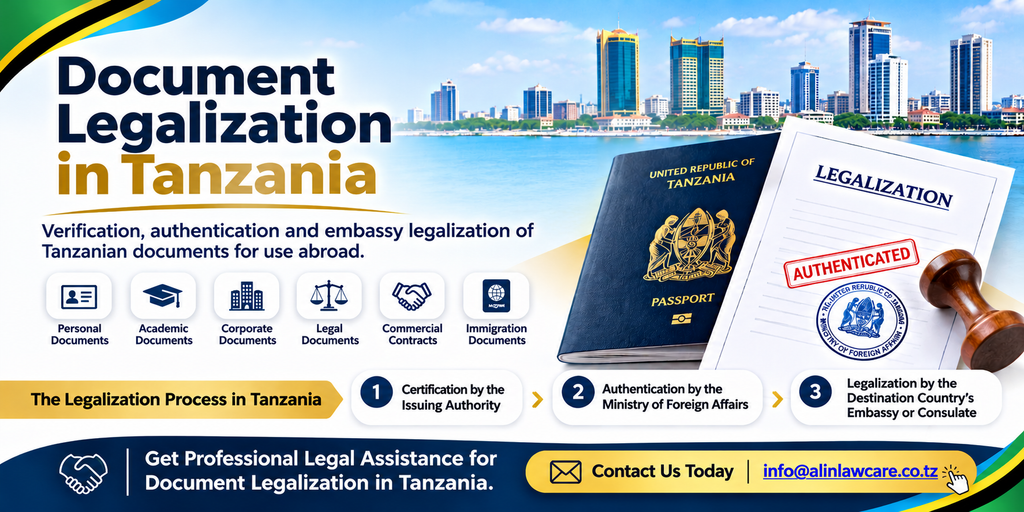
Document Legalization and Attestation in Tanzania: Requirements, Procedures and Legal Guide
Document legalization and attestation in Tanzania is an essential process for individuals, businesses, foreign investors and institutions intending to use Tanzanian documents abroad. Whether you are applying for employment overseas, pursuing international education, establishing a foreign business, processing immigration applications or undertaking cross-border commercial transactions, your documents may require legalization before they can be accepted by foreign authorities.
At Alin Law Care, we provide professional document legalization, authentication and embassy attestation services in Tanzania, assisting both local and international clients throughout the process.
1. What Is Document Legalization?
Document legalization is a formal procedure through which the authenticity of signatures, official stamps, seals and the capacity of persons signing public documents are verified for use in another country.
Tanzania’s conventional document legalization procedure generally involves certification by the relevant local authority, authentication by the Ministry responsible for Foreign Affairs and, where required, legalization by the diplomatic mission of the destination country.
Unlike the simplified apostille procedure established under the Hague Apostille Convention of 1961, conventional legalization may involve several government authorities and diplomatic missions.
Legalization does not necessarily establish the accuracy of the contents of a document or guarantee its acceptance abroad. The receiving authority may impose additional legal and administrative requirements.
2. Is Tanzania a Member of the Hague Apostille Convention?
Tanzania is not a contracting party to the Hague Apostille Convention of 5 October 1961, which abolishes the requirement for conventional legalization of foreign public documents between participating countries. Status table
Consequently, Tanzanian public documents intended for use abroad generally require conventional authentication and legalization, unless the destination country provides an exemption or alternative recognition procedure.
Even where the destination country is a member of the Apostille Convention, Tanzanian documents do not automatically qualify for apostille certification.
3. Why Is Document Legalization Important?
Document legalization plays an important role in facilitating international legal, educational and commercial transactions. It helps foreign authorities establish confidence in documents originating from Tanzania.
The principal purposes of document legalization include:
- Facilitating international employment and immigration applications.
- Supporting admission to foreign universities and educational institutions.
- Facilitating international business and investment transactions.
- Supporting marriage and family-related applications abroad.
- Preventing document fraud, forgery and misrepresentation.
- Facilitating cross-border legal proceedings.
- Supporting international professional registration and licensing.
- Meeting foreign government and regulatory requirements.
Failure to properly legalize documents may result in rejection, administrative delays or additional expenses.
4. Types of Documents That Can Be Legalized in Tanzania
Alin Law Care assists clients with the legalization and attestation of various personal, academic, corporate and legal documents.
| Document category | Examples |
|---|---|
| Personal documents | Birth certificates, marriage certificates, death certificates and divorce decrees |
| Academic documents | Degree certificates, diplomas, academic transcripts and professional qualifications |
| Corporate documents | Certificates of incorporation, memoranda and articles of association, board resolutions and company registry extracts |
| Legal documents | Powers of attorney, affidavits, statutory declarations and court orders |
| Commercial documents | Commercial contracts, invoices, certificates of origin and agency agreements |
| Immigration documents | Police clearance certificates, employment contracts and supporting immigration records |
| Professional documents | Professional licences, practising certificates and experience certificates |
The applicable legalization procedure depends on the nature of the document, its issuing authority and the requirements of the destination country.
5. How to Legalize Documents in Tanzania: Step-by-Step Procedure
The document legalization process in Tanzania generally involves three principal stages.
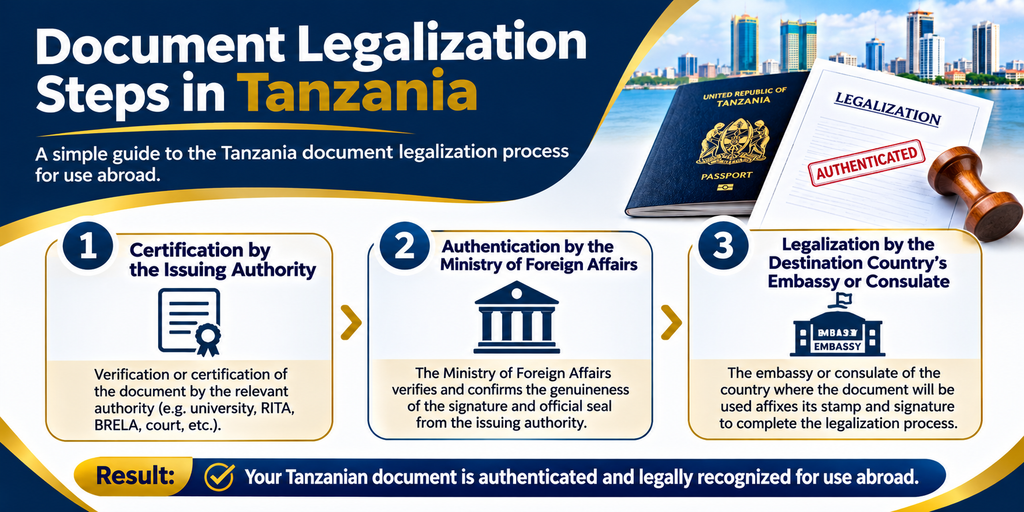
Stage 1: Verification by the issuing authority
Initial certification and verification of the document.
Stage 2: Ministry of Foreign Affairs authentication
Authentication of the relevant official signatures and seals.
Stage 3: Embassy or consular legalization
Final diplomatic authentication, where required.
Stage 1: Certification and Verification by the Relevant Authority
The first stage involves obtaining verification or certification from the issuing institution or relevant competent authority in Tanzania.
Depending on the document, the relevant authorities may include:
| Document | Relevant authority |
|---|---|
| Birth, marriage and death certificates | RITA or the competent civil registration authority in Zanzibar |
| Academic certificates | Issuing educational institution and relevant education authority |
| Company registration documents | BRELA or BPRA in Zanzibar, as applicable |
| Court judgments and orders | Relevant court registry |
| Police clearance certificates | Tanzania Police Force |
| Affidavits and private legal documents | Notary public, commissioner for oaths or other competent authority, as applicable |
Certain documents may require additional verification, registration or notarization before submission to the Ministry of Foreign Affairs.
Stage 2: Authentication by the Ministry of Foreign Affairs
Following initial verification, the documents are submitted to the Ministry of Foreign Affairs and East African Cooperation (MFAIC) for authentication.
The Ministry verifies the relevant signatures, stamps and official seals appearing on the documents.
This stage is particularly important because foreign embassies generally require authentication by the Ministry before undertaking consular legalization.
The Ministry’s published guidance requires prior verification by the issuing authority and may require original documents, supporting copies and an application letter. foreign.go.tz+1
Stage 3: Legalization by the Foreign Embassy or Consulate
After authentication by the Ministry of Foreign Affairs, the documents may be submitted to the embassy, high commission or consulate representing the destination country.
The diplomatic mission authenticates the relevant signature or seal of the Ministry of Foreign Affairs official.
Depending on the destination country, additional authentication may also be required after the documents arrive abroad.
Where the destination country does not maintain a diplomatic mission in Tanzania, legalization may need to be processed through an accredited embassy located in another country.
6. Requirements for Document Legalization in Tanzania
Although requirements vary depending on the type of document and destination country, applicants may generally be required to provide:
- Original documents or acceptable certified copies.
- A copy of a passport or national identification document.
- Details of the country where the documents will be used.
- Information concerning the intended purpose of the documents.
- An authorization letter or power of attorney, where applicable.
- Certified translations, where required.
- Supporting verification letters from issuing institutions.
- Payment of applicable government and embassy fees.
It is advisable to confirm the specific requirements before commencing the legalization process.
7. How Long Does Document Legalization Take in Tanzania?
The processing time for document legalization in Tanzania depends on several factors, including the type of document, verification requirements, government processing schedules and the availability of the relevant diplomatic mission.
Documents requiring verification by multiple authorities or legalization through an embassy outside Tanzania may take longer.
Applicants are advised to commence the process well before their employment, immigration, university admission or commercial transaction deadlines.
Alin Law Care provides an estimated processing timeline after reviewing the documents and confirming the applicable legalization requirements.
8. Document Legalization for Clients Living Abroad
Individuals and companies located outside Tanzania may engage a professional legal representative to coordinate the legalization of their Tanzanian documents.
Subject to the requirements of the relevant authorities, clients may not need to travel to Tanzania personally.
Alin Law Care can coordinate document receipt, verification, government authentication, embassy legalization and secure international courier delivery.
This service is particularly beneficial to Tanzanians living abroad, international recruitment agencies, foreign employers, multinational companies and international law firms.
9. Common Mistakes to Avoid When Legalizing Documents
Applicants frequently experience unnecessary delays because of the following mistakes:
- Submitting documents without prior verification.
- Presenting photocopies where original documents are required.
- Submitting laminated or damaged certificates that cannot be authenticated.
- Providing documents containing inconsistent personal information.
- Using unauthorized translation services.
- Assuming that notarization alone constitutes full legalization.
- Submitting documents to the wrong diplomatic mission.
- Assuming that Tanzania issues apostille certificates under the Hague Apostille Convention.
Engaging an experienced legal service provider can help identify these issues before submission and reduce the risk of rejection.
10. How Alin Law Care Can Assist
Alin Law Care provides comprehensive document legalization and attestation services in Tanzania to individuals, corporate clients, international law firms, recruitment agencies and foreign institutions.
Our services include:
- Reviewing documents and advising on applicable legalization requirements.
- Coordinating verification with relevant issuing authorities.
- Providing notarization and certification services where applicable.
- Coordinating authentication by the Ministry of Foreign Affairs.
- Facilitating embassy and consular legalization.
- Coordinating certified document translations.
- Assisting with legalization through diplomatic missions outside Tanzania.
- Monitoring applications and providing progress updates.
- Arranging secure international courier delivery of legalized documents.
Our objective is to simplify the legalization process, minimize administrative delays and ensure that documents meet the applicable authentication requirements.
11. Frequently Asked Questions (FAQs)
Is Tanzania an apostille country?
No. Tanzania is not currently a contracting party to the Hague Apostille Convention of 1961. Conventional legalization is generally required unless an exemption applies.
Where can I legalize documents in Tanzania?
Documents are generally verified by the relevant issuing authority, authenticated by the Ministry of Foreign Affairs and subsequently legalized by the appropriate foreign diplomatic mission, where required.
Can I legalize my Tanzanian birth certificate while living abroad?
Yes. Subject to the applicable requirements, a legal representative in Tanzania can coordinate the process on your behalf.
Can Alin Law Care legalize my degree certificate and academic transcripts?
Yes. Alin Law Care can coordinate verification with the relevant educational institutions and authorities, Ministry of Foreign Affairs authentication and embassy legalization.
What is the difference between notarization and legalization?
Notarization involves formal certification of signatures, copies or legal instruments by an authorized person. Legalization involves further authentication for recognition by foreign authorities. Notarization alone may not satisfy international document requirements.
Can a photocopy of a document be legalized?
This depends on the document and the requirements of the receiving authority. Some authorities accept certified copies, while others insist on original documents.
Can foreign documents be legalized for use in Tanzania?
Yes. Foreign documents may require authentication in their country of origin, verification by the relevant diplomatic mission and further authentication in Tanzania, depending on the applicable requirements.
Can company documents be legalized for international business transactions?
Yes. Corporate documents, including certificates of incorporation, board resolutions, powers of attorney and company registry extracts, may be authenticated for international commercial transactions.
What happens if the destination country has no embassy in Tanzania?
The documents may need to be submitted to the diplomatic mission accredited to Tanzania but located in another country. Alin Law Care can assist in identifying and coordinating the appropriate legalization route.
Does legalization guarantee that my documents will be accepted abroad?
No. Legalization confirms relevant signatures, seals and official authority. The receiving institution retains the right to assess the document’s substantive validity and impose additional requirements.
Can legalized documents be delivered internationally?
Yes. Alin Law Care can arrange secure international courier delivery upon completion of the legalization process.
Conclusion
Document legalization and attestation in Tanzania is an important procedure for individuals and businesses seeking to use Tanzanian documents internationally.
Understanding the applicable requirements, obtaining the correct verification and following the appropriate authentication procedures can significantly reduce delays, administrative complications and the risk of document rejection.
Engaging a professional legal service provider such as Alin Law Care enables clients to navigate the process efficiently, whether they are based in Tanzania or overseas.
Contact Alin Law Care for Document Legalization Services in Tanzania
Do you need to legalize a birth certificate, marriage certificate, degree certificate, power of attorney or corporate document for use abroad?
Alin Law Care is ready to assist you throughout the entire document legalization and attestation process, from initial verification to final embassy legalization and international delivery.
#DocumentLegalization #DocumentAttestation #TanzaniaLegalization #EmbassyAttestation #MOFAAttestation #CertificateLegalization #DocumentAuthentication #LegalServicesTanzania #AlinLawCare